
Delusional Reality
Book Club: Not Just for Fridays Anymore

Man has always assumed that his is the highest form of life in the universe. There is, of course, nothing at all with which to sustain this view.
~ James Thurber
Once upon a time, we didn’t pay much attention to people who believed in crazy conspiratorial thinking. We ignored and sometimes humored them, but they didn’t impact our lives – unless we had to deal with them within the family.
Now they influence and initiate laws and policies affecting the daily lives of people everywhere. As I thought about how we got here and how much worse things will likely get, it brought back childhood memories I had long forgotten.
Few wonders for a kid growing up in 1960s and 70s America could match grocery store checkout aisles. Imagine being surrounded by “newspaper headlines” you’d never see anywhere else. They made the unimaginable seem possible.
Aliens probing folks in the middle of nowhere. They also built ancient pyramids from Egypt to the Mayan empire. And just what exactly are secret government labs up to now? Finally, news a kid could appreciate.
Thankfully, for virtually all of us, that naïve stage, if it even existed in the first place, quickly passed. For me, this might well have been my first step toward adulthood. I don’t remember seeing anyone buy a copy. No one I knew ever admitted doing so. But they must have sold. Why else were there new copies every week?
The National Enquirer focused more on the latest celebrity “news,” much of which was made up. By the 1990s, it tried to straddle the line with reality by adding some legitimate news, more often than not salacious, every now and then. By the 2016, it was integral to a successful presidential campaign.
The greatest difference-maker, though, was the internet. No longer did one have to risk being seen in public, it could be done in one’s privacy. But what happened next might be best explained by a joke told in 2002 by German comedian Frank-Markus Barwasser, aka Erwin Pelzig:
I’ll say one thing about the subject of the internet, ok? Never before in the history of mankind could so many idiots spread so much nonsense so quickly and so widely! OK, this is nothing new. There’ve always been idiots in the history of mankind, but…
They didn’t know about each other! Today they can meet each other immediately, www.globalcompleteidiot.de, or worse yet, www.terror.com![1]
Now they do, indeed, know about each other. To make up for the absence of intellectual logic, not to mention moral consistency, they gussy up their toxic fairy tales for polite society with a term that creates the illusion of thinking to come to a conclusion or opinion: conspiracy theories.
We do ourselves no favors by calling wildly speculative irrationalities conspiracy theories. The word theory alone provides the cover of unearned legitimacy, implying it is an idea in an otherwise rationally thinking mind.
These are not, by any definition, theories. Nothing close to thinking, comparing, discussing, reevaluation, contemplation, or sound decision-making has ever been based on them.
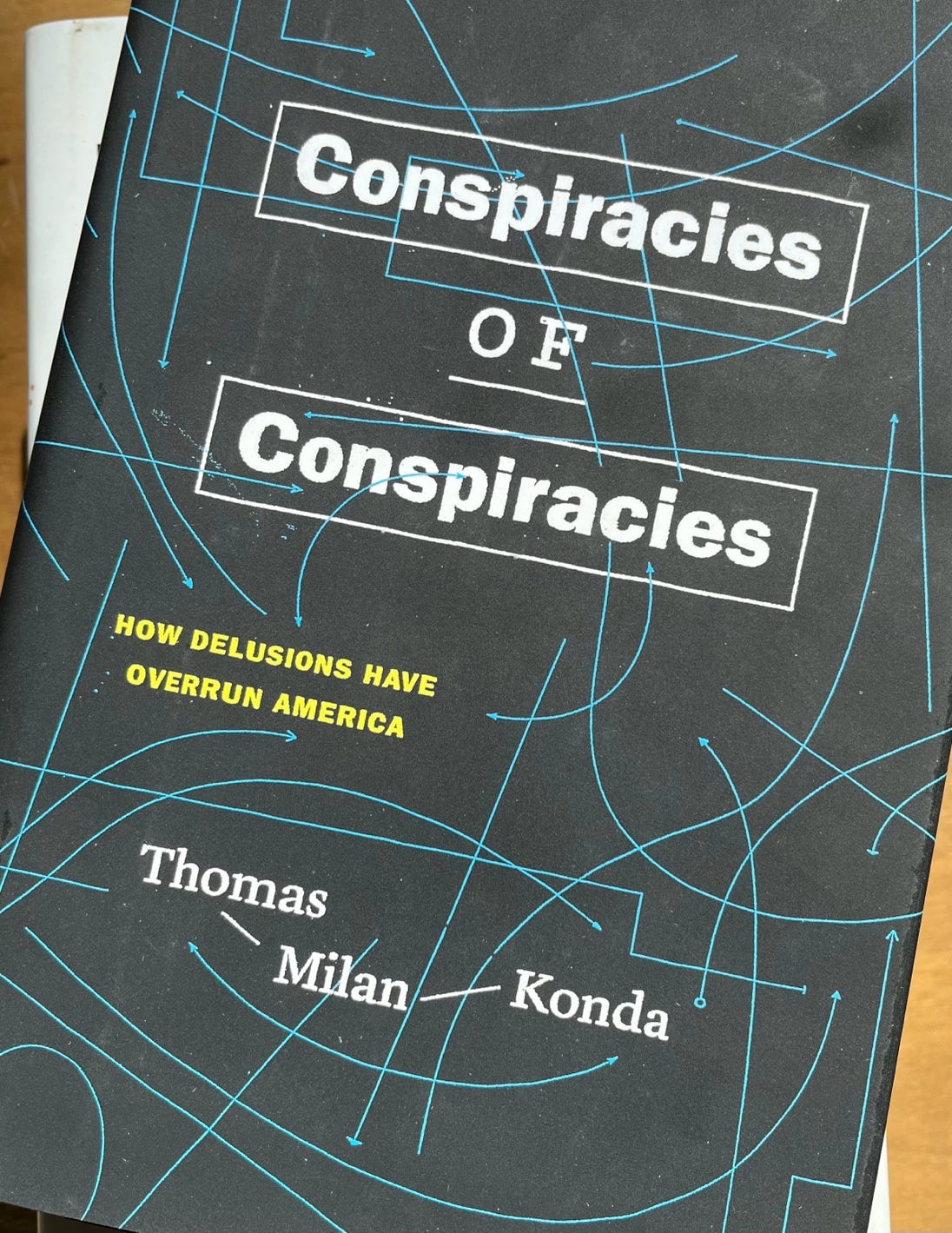
According to Thomas Milan Konda’s Conspiracies of Conspiracies: How Delusions Have Overrun America, conspiracists act “according to…predispositions [which are] fitted [to] the events of the day into an already established conspiratorial framework.” Most important is “a sense of righteousness that…exaggerates the ‘otherness’ of one’s opponents.”
Konda proposed a more precise word to replace the inaccurate term “conspiracy theory”: “conspiracism, a belief system” that is “self-sealing,” prompting “people to look for conspiracies, to anticipate them, to link them together into grander overarching conspiracy.” [Emphasis added.] Moreover, this mindset “creates a dualistic narrative in which the malevolent conspirators secretly work to destroy everything that is good and pure.”
Conspiracisms “delegitimize moderate views, again feeding into a dichotomous world-view in which people are either with or against you.” Empirical reality becomes malleable, longing for history a contrived past that never existed. Frustration becomes a motivational cudgel. If they (whoever they are) don’t agree, then they may well be a part of the conspiracy…or worse.
In the past thirty years, media technology has turbocharged them, quickly moving from faxes and new-fangled wireless phones to the digital age of proliferating social media. Conspiracisms have literally become hazardous to public health, political and otherwise, motivating true believers and fellow travelers to actively lie about reality and history to feed more distortions, including embedding them into public policies that impact everyone.
In the event that conspiracists do not win at the ballot box, permanently gumming up the works of democratically-based governing to widen the perception that it is frustratingly ineffectual will do nicely. Especially if political minorities can be blamed and punished in the deal.
Conspiracists’ voices and influence ramped up dramatically shortly after the September 11 attacks on American soil. People with crazy ideas demanded to be taken seriously: “It was an inside job, government-led. The hijackers got away! Did the planes even hit the Trade Towers, the Pentagon or crash in Pennsylvania?”
September 11th “trutherism” was born. The 2008 financial crisis didn’t help. Nor did the election of a Black man to the presidency of the United States.
This caused far too many to rationalize the election of Barack Obama as national absolution for all prior racially-based sins. Indeed, any claims of discrimination made by Black Americans to be moot. The whole concept of racial equity was turned on its head and became racist in and of itself.
Konda identifies two essential ideas conspiracists share, an “arrogance of narcissism” and a “perceived persecution” against them. Recall that this was written and published well before Donald Trump rode down the golden escalator into public life, well before Covid-19, and well before January 6.
Add to that a penchant for extrapolating personal experience to draw universal conclusions that, according to true believers, logically and obviously explains all. Election denialism, for example, comes down to: “I don’t know anyone who would vote for him/her, therefore something is wrong.” Misconceptions about climate change often come down to not knowing the difference between weather and climate.
“Both-siderism” balances and give equal weight to nonsensical comparisons, many of which nurture and legitimize fictions as facts, especially political ones. Having your cake and eating it too became “legitimized” by a more baffling justification for conspiracisms:
“Denialism”…differentiate(s) between professing a conspiracy theory and merely refusing to accept a well-established official explanation…Contemporary denialism, however, is more than just a refusal to believe: it is an active process—what Robert Proctor calls “agnotology” or “the cultural production of ignorance.”…The mistrust of much of the public came to direct at government spilled over to science, especially in the area where the two were intertwined, such as public health.
Add to this “a sense of righteousness that is hard to imagine” which “exaggerates the ‘otherness’ of one’s opponents [by] its tendency to delegitimize moderate views, again feeding into a dichotomous world-view in which people are either with or against you.”
I first understood how deep these divisions were when public restrictions began to ease during the pandemic. Wearing a mask in public places—ostensibly to protect others in case one was an asymptomatic carrier of the Covid virus—became not an act of public health or even basic decency.
Many like me were subjected to threatening, hateful stares, palpably verging on violence. Who knew then these feelings would become foundational principles of the nation itself?
Science denialism also feeds conspiracism-adjacent claims, ignoring the scientific method itself or distorting it beyond recognition.
When I first learned about myeloma in 1996, it was considered a sure death sentence for every patient. An understandable desperation led patients along the “secret therapy” patient grapevine. The advent of the internet turbocharged these as it took hold on society.
Had some of those stories turned out to be true, the spice turmeric would, by now, have cured myeloma. If not that, then certainly sea cucumbers would. I knew one patient who got a steady supply of them from another patient who was importing them to add to his daily diet. Or there must be some herbal cure.
Ideas like this proliferate, usually among the most desperate people. The best we can hope for is that they do no harm. Yet they continue to proliferate, become ensconced, and unceasingly strive to replace the actual world with self-satisfying, comforting illusions.
History has seen this before. It’s worth a look, if only to compare to our current reality.
Richard Evans, a British historian widely considered to be the most authoritative living scholars on the Third Reich, saw some fundamental similarities between his area of expertise and the current state of the world. The Hitler Diaries examines five conspiracisms connected to the rise of Naziism and Adolf Hitler. Regardless,
This is a history book, but it is a history book for the age of “post-truth” and “alternative facts”, a book for our own troubled times.
His first was example is the primary source of modern anti-Semitism, The Protocols of the Elders of Zion. Concocted and published in late-19th century Russia, this fiction of conspiracisms spread vicious myths as the truth. Jews, according to The Protocols “were engaged in a worldwide conspiracy to overthrow society and its institutions.”
Jewish treachery, duplicity against established political power (it used to be just Christians), and a world-wide conspiracy controlled the world with an invisible hand.
The Protocols, although easy to dismiss, took on a life of their own. Even people who knew absolutely nothing about them took its conclusions as gospel. They acted on these perverted fairy tales in substantive, corrosive social, political, and legal ways.
Seen from today’s vantage point, Germany was relatively untouched – although often cultural anti-Semitism still existed – through World War I. Jews served the German Empire (the Second Reich) faithfully, many were heroes on the battlefronts. Regardless, the lies of The Protocols stayed alive, and continue to do so.
The second conspiracism Evans cites, the “stab-in-the-back theory” (der Dolchstoss Legende), accelerated the spread of these lies – most notably in Germany, although it continued to spread worldwide. According to this “theory,” Germany would have won World War I had it not been for the treasonous actions of leftists on the home front who betrayed the army. This, plus the draconian terms against Germany in the Versailles peace treaty, eventually became the basis for the eventual victory of the Nazis and the short period of alignment (Gleichschaltung) with party policy and consolidation of power.
Because of these two conspiracisms, irrational hate, based on fictions became actual public policy and law. The history of this era demonstrates that nothing deters true believers from trusting in conspiracies. Given proof countering their beliefs, true believers re-rationalized their preconceived conclusions. Truth doesn’t matter.
Shortly after the Nazis took control of Germany, propaganda minister Joseph Goebbels wrote in his diary, “I believe in the inner, but not the factual, truth of The Protocols.” Because, despite facts, it “expressed an essential truth that in the end was not susceptible to empirical verification at all.”
Conspiracists’ sincere beliefs, their depth of conviction, becomes currency used to substitute facts and the scientific method.
Conspiracisms live on, since ideology, what people hold as a sincere belief, becomes legal currency to manipulate into absolute political power. And those “beliefs,” which bear little-to-no resemblance to the truth are not-so-well-hidden, built on “evidential edifices of such staggering detail and complexity that they are frequently almost impossible for the layperson to navigate.” Confusion validates truth.
By publicly broadcasting this tripe, whatever its source (radio, television, internet), provides a veneer of legitimacy for anyone who “lived in a hermetically sealed cocoon which could not be penetrated by any rational criticism.” One common thread, although variations on the theme exist. Terrifyingly, these lies serve a larger idea, one that is devoid of democratic debate, of uncertainty that is inherent in life, and in which any political pluralities not ceded to them as insidious aberrations.
In the case of the “stab-in-the back” conspiracism, “Germans’ refusal to accept the fact that they had lost,” created “progressive polarization…which saw an ever more radical nationalist, authoritarian and anti-socialist right confronting an increasingly critical, oppositional and ultimately revolutionary left.”
We know where that led. Our world is still affected by it more than 100 years later.
Remember when Trump created a conspiracism to jumpstart his political ambitions? The one that goes a little something like this: in early 1960s Hawaii, a single, white mother of a newly born biracial child forged his birth documents, because he was “supposedly” born in Indonesia. According to this “reasoning,” she must have been motivated by a premonition that her son would be the first Black president of the United States.
Those who believe in this sinister fairy tale can easily be convinced a personalized birthday greeting made by Trump to sexual predator Jeffrey Epstein is a fake as well. Or as Trump desperately claims, a “Democrat [sic] hoax.” That would mean Democratic operatives forged the card decades ago because they apparently had the magical power to anticipate a Trump presidency decades later.
Why conspiracisms thrive is simple. In large part, they are nurtured by the instant gratification of modern technology, especially social media, and a society and individual inability to focus and concentrate on problems whether they be immediate, medium- or long-term, complex, individual, or social, political or governmental. Everything merges into one morass screaming for simple solutions.
Conspiracisms fit the bill, justifying what some desperately want to believe is true. In that world, putting in the effort to actually become educated becomes a pejorative. Indeed, I can see how conspiracists themselves might see a book threading together more than two centuries of conspiracisms could be conspiratorial in and of itself.
Conspiracisms are foundational to almost every non-democratic, authoritarian regime, and reactionary movement in the world. Putin’s reign in Russia, Orban in Hungary, and the AfD in Germany are obvious examples. Plus the fact they are aligned with the American political party that now controls all three federal branches, majorities of state governorships and legislatures, and openly embraces conspiracisms to consolidate absolute power and privilege.
In a fulfillment of Barwasser’s joke about conspiracists not knowing about each other, the National Enquirerbecame an arm of Trump’s 2016 presidential campaign, famously implementing a “catch and kill” strategy to pay off and sign witnesses to nondisclosure agreements to prevent these stories from seeing the light of day. A wannabe legitimate newspaper was spending money not reporting the news.
Konda’s conclusion doesn’t inspire hope.
It may be comforting to think that the situation will resolve itself or that a shift in political beliefs will undo it. But the evidence suggests otherwise.
Writing for the online periodical The Red Pepper, shortly before passing away in 2022, Konda was not defeatist, despite seeing his thesis come to life:
Do not give it time to sink in, unopposed, into the public’s consciousness. The speed with which stupid ideas are debunked makes a great deal of difference... Referring to anything suspicious or to any unusual belief as a “conspiracy theory” does considerable harm by normalizing conspiracy thinking. The person who thinks that perhaps Bigfoot may be real will, on hearing that belief called a conspiracy theory, thinks, “Well, I guess I must be a conspiracy theorist. Okay.” We may never eliminate conspiratorial thinking, but we can try to move it out of the acceptable mainstream.
Evans has a warning, however. Debunking conspiracisms takes much more effort than it does to spread them.
Working out what really happened in history is difficult: it requires a great deal of hard work, it demands direct examination of the evidence, it presupposes a willingness to change one’s mind, it involves the abandonment of one’s prejudices and preconceptions in the face of evidence that tells against them.
On the other hand, rampant conspiracisms making the rounds these days bring to mind Joseph Heller’s immortal quote from the novel Catch-22 :
Just because you're paranoid doesn't mean they aren't after you.
Correction: As some of you may have noticed, I messed up posting the last headline, which should have read: Florida’s Dred Scott Effect.
Seems I haven’t quite figured out how this cut & paste thing works. Please forgive my oversight and the many little edits I miss at first in so many of my posts. I eventually get them right for digital posterity thanks to many of you!
Thomas Milan Konda, Conspiracies of Conspiracies: How Delusions Have Overrun America, The University of Chicago Press, 2019.
[1] „Ich sag Ihnen einmal eines zum Thema Internet, ja. Noch niemals zuvor in der Menschheits Geschichte konnten so viele Idioten, so viel Unsinn, so schnell, soweit verbreiten! Ja, gut. Des iss jetzt nett neu. Weil Idioten hat’s schon immer gegeben in der Menschheits Geschichte, aber…
Die wussten nix voneinander! Heute können die sich sofort kennenlernen, www.globallevolldepp.de, oder noch schlimmer, www.terror.com!“